
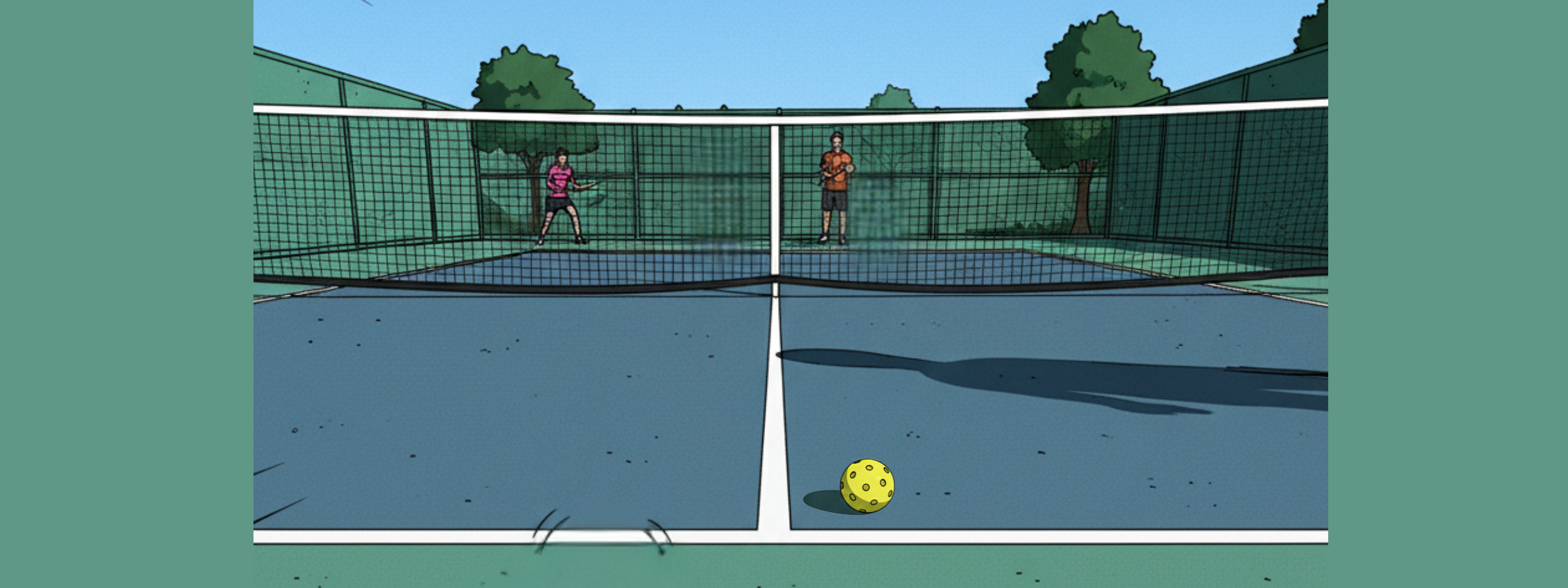
A: Fast, deep serves don’t beat you because they’re “too good.”
They beat you because they rush your preparation.
Most missed returns against big servers come down to three things: late feet, late paddle prep, and trying to do too much with the ball. The goal of the return isn’t to win the point. It’s to neutralize the serve and give you time to get to the kitchen in balance.
If you can return deep, high, and repeatable, fast servers lose their edge quickly.
First: understand the real job of the return
A strong return does three things:
- Pushes the serving team back
- Buys you time to move forward
- Forces a tougher third shot
That’s it. You don’t need pace. You don’t need spin. You need depth and height.
For most players, the default target should be deep middle. It’s the biggest part of the court and creates hesitation. If you’re comfortable, deep cross-court to the server’s backhand is also a strong, high-percentage option. What you don’t need is the sideline.
You need depth.
Why fast serves feel harder than they are
Speed shrinks your decision window.
When the ball is moving fast, your instinct is to swing faster, shorten your backswing too much, or flick at it late. Sometimes players overswing. Sometimes they tighten up and decelerate. Either way, timing changes.
The fix isn’t a bigger swing.
It’s earlier preparation and simpler intent.
- Get your feet set early
Your return starts before the serve is struck.
As the server begins their motion, settle into a light, athletic stance. As they contact the ball, perform a small split-step. That tiny bounce keeps your feet active and prevents you from getting stuck flat-footed.
Then move first.
Even one adjustment step behind the ball changes everything. Your goal is simple: get your body behind the ball so contact happens in front of your lead hip — not beside you, not jammed into your torso.
Late feet are the number one reason returns float short.
- Prepare the paddle early and keep it compact
Against big serves, your swing should feel controlled and repeatable.
Turn your shoulders early. Keep the paddle back just enough to allow a smooth forward motion. Not a huge loop. Not a stab.
Think: smooth through the ball, not quick at the ball.
Let your weight move forward through contact. If you’re falling backward or leaning away from pace, depth disappears. If balls are sailing long, you’re likely swinging too hard. Cut your swing speed by 20 percent and let the server’s pace do the work.
If balls are landing short, you’re probably contacting late or decelerating. Prepare earlier and swing through smoothly.
- Aim higher than you think
One of the biggest mistakes against fast serves is trying to hit a low, flat laser back.
High is your friend.
A slightly higher trajectory gives you margin over the net and natural depth. The ball travels deeper with less effort, and you buy time to move forward.
On serves and returns, think:
- Deep middle first
- Cross-court to backhand if comfortable
- Height before lines
You don’t need to win the rally with the return. You need to start it well.
- Don’t move forward until after contact
Many players get excited to reach the kitchen and begin drifting forward while they’re swinging. That’s when returns float short.
Hit first.
Then move.
Even if the return is short, finish your swing, land balanced, and then transition forward. Move behind your shot, not during it.
If your return is high and deep, you’ll have time.
- Use the serve’s pace instead of fighting it
Fast serves give you free energy.
You don’t need to generate much power. Focus on direction and height. A smooth, forward swing is enough.
If you try to overpower pace, timing suffers. If you trust the incoming speed and stay compact, consistency improves immediately.
What to avoid
Avoid trying to win the return.
Avoid aiming for lines.
Avoid adding spin you don’t already own.
Avoid backpedaling if the serve pushes you deep — pivot and shuffle instead to protect balance.
Fast serves test discipline more than skill.