
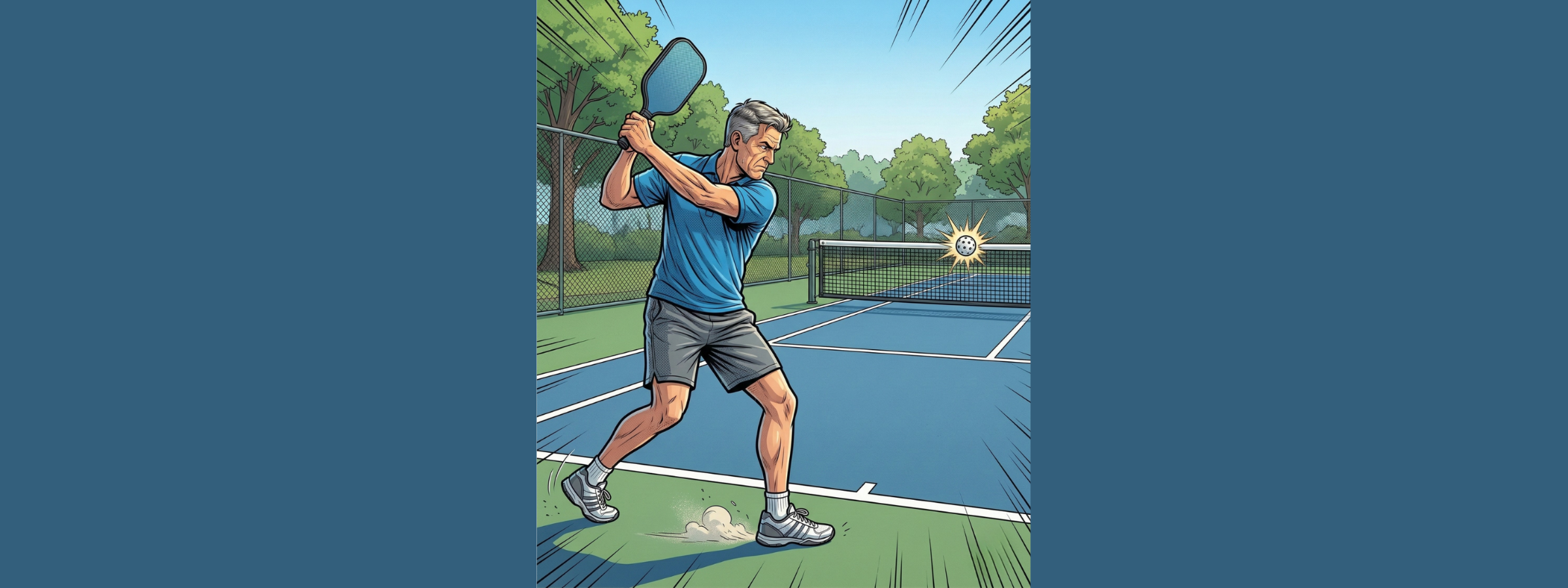
A: Few shots frustrate players more than the third shot drop — especially when it keeps landing in the net.
You know what you want to do.
You understand the idea of the shot.
But when the return comes back deep, the drop either falls short or never clears the tape.
The problem usually isn’t the drop itself.
It’s how you’re trying to hit it.
Most players miss drops into the net because they try to manufacture softness with their hands instead of creating lift with their body and paddle path.
A good third shot drop isn’t a flick.
It’s a controlled lift.
First: understand the real job of the drop
The third shot drop doesn’t have to be perfect.
It doesn’t need to skim the net.
It doesn’t need to land right at their feet.
Its job is simple: clear the net safely, land somewhere in the kitchen, and give you time to move forward.
Many drops land in the net because players aim too low. They try to be precise instead of reliable.
A drop with a little extra arc is far better than one that never clears the net.
Your drop doesn’t need to be pretty.
It just needs to be playable and buy you time.
Second: stop trying to “soften” the ball with your hands
When players think “soft shot,” they often slow their swing down too much or poke at the ball.
That’s when the ball dies before it reaches the net.
Instead of trying to take speed off the ball with your hands, think about lifting the ball with your swing path.
Keep a slightly open paddle face so the ball naturally gets height without you scooping it.
Use a relaxed grip — about 3 or 4 out of 10. A softer grip lets the ball sit on the paddle a fraction longer, which makes that smooth, upward push easier.
The paddle should travel low to high, not straight at the net.
One simple image helps: imagine you’re gently tossing the ball over a low fence with your paddle.
That picture alone fixes a lot of netted drops.
Third: contact the ball farther in front
Many drops land in the net because contact happens too close to the body.
When the ball reaches your hip, your paddle path naturally flattens out and the ball loses lift.
Try to meet the ball a paddle-length in front of your body.
That forward contact makes it much easier to create the upward path the drop needs.
If the ball drifts beside you or behind you, the shot becomes much harder.
Fourth: give the ball more height
This is the biggest mental shift.
Most players aim far too low.
If your drops keep hitting the net, the easiest fix is simply aim higher.
A ball that clears the net by two or three feet still lands safely in the kitchen because it slows down as it travels.
More height means more forgiveness.
You’ll miss fewer drops even on off days.
Fifth: move through the shot
Another common mistake is trying to hit the drop while leaning backward or standing still.
When your weight is falling away from the ball, it’s difficult to create lift.
Instead, move forward through the shot.
Step into the drop, shift your weight toward the net, and continue advancing after contact. The forward motion naturally helps produce a softer, higher ball.
Sixth: recognize the type of third shot you need
Not every third shot drop is the same.
Sometimes you’re in control. Sometimes you’re just trying to neutralize.
If the return lands inside the baseline or sits up, you can hit a more controlled drop and move forward behind it.
If the return drives you two steps behind the baseline, don’t try to force a perfect drop. Use a higher, safer neutralizing third that simply buys time.
In other words:
Some thirds are attacking drops.
Some are neutralizing drops.
Both are good shots if they get you to the kitchen safely.
Drills to fix the problem quickly
Height Over the Net Drill
From the baseline, hit drops that clear the net by 2–3 feet and land at least halfway into the kitchen. Do sets of ten and only count the rep if both happen — good height and proper depth.
Forward Contact Drill
Place a cone or marker about a paddle-length in front of your lead foot. Practice meeting the ball there.
If the ball gets to your hip or behind you, let it go in practice and restart. Train yourself to recognize late contact instead of forcing the shot.
Walk-In Drop Drill
Start at the baseline, hit a drop, then take two or three steps forward.
Once that becomes comfortable, start the drill two steps inside the baseline so you learn to hit drops from different depths on the court.
A quick self-check during matches
If your drops keep hitting the net, ask yourself:
Am I contacting the ball in front?
Am I giving the ball enough height?
Am I lifting with my body instead of poking with my hands?
Usually one of those answers reveals the problem.
A simple on-court cue
When in doubt, remember this phrase:
Low to high, out front, keep walking.
Those four ideas fix most third-shot drop problems.
The real key
The third shot drop isn’t a delicate trick shot.
It’s a repeatable lift.
Clear the net comfortably.
Give the ball shape.
Move forward behind it.
When you stop trying to hit the perfect drop and start aiming for a reliable one, the net suddenly stops being such a big problem.