
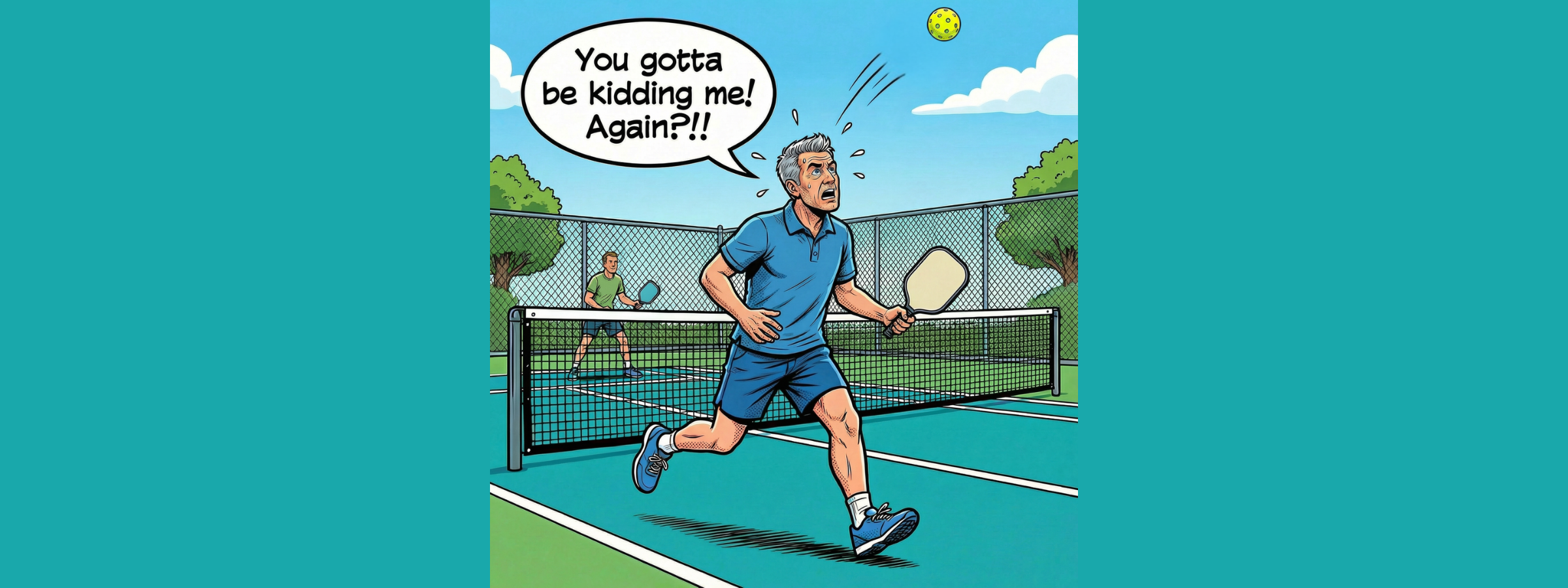
Playing against constant lobs can feel chaotic.
You get to the kitchen… and the ball goes over your head.
You move back… and the next one drops short.
You hesitate… and suddenly you’re out of position again.
It doesn’t feel like “normal” pickleball.
But here’s the key:
Lob-heavy players aren’t beating you with variety.
They’re beating you with movement and indecision.
Once you clean that up, the lob stops being a weapon.
First: understand what the lob is trying to do
A lob isn’t just a defensive shot.
Used repeatedly, it’s meant to:
- Push you off the kitchen
- Break your positioning
- Create confusion between partners
- Force awkward movement and rushed decisions
Most points aren’t lost on the lob itself.
They’re lost on what happens next — the hesitation, the scramble, the poor contact.
That’s where you win the matchup.
Second: decide early — back or take it in the air
The biggest mistake against lobbers is hesitation.
You see the ball go up… and pause for a split second trying to decide:
“Do I go back… or can I take this?”
That delay is what gets you beat.
Instead, make an early decision:
- If you can take it above your head in balance → take it in the air
- If it’s clearly going over you → turn and go immediately
No in-between.
And one more piece players miss:
If the ball is clearly sailing long, let it go and call “out” early for your partner.
You don’t have to play every lob.
Third: move correctly (this is everything)
When you go back for a lob, how you move matters more than how fast you move.
Do not backpedal.
Backpedaling puts you off balance and increases your risk of falling, especially on deeper lobs.
Instead:
- Turn your shoulders first
- Pivot or drop-step
- Use crossover or side-shuffle steps
For shorter lobs, a few quick shuffle or crossover steps are enough.
For deeper lobs, turn and run, then slow down as you get into position.
That adjustment between shuffle and full run is what keeps you balanced.
Fourth: don’t try to win the point from a bad position
This is where most players lose.
They chase a lob, get slightly off balance… and then try to crush an overhead winner anyway.
That usually leads to:
- Missed smashes
- Balls into the net
- Easy counters
If you’re not fully set, don’t force it.
Better options:
- Hit a controlled overhead back deep
- Reset the ball into the kitchen
- Play a neutral shot and recover
You don’t have to punish every lob.
You just have to stay in the point.
Fifth: recover forward immediately
The biggest hidden mistake after chasing a lob is staying back.
You hit the ball… and watch it.
That gives your opponents exactly what they want — you stuck deep in the court.
After every lob retrieval:
- Move forward right away
- Regain your position at the kitchen
- Reconnect with your partner
The goal isn’t just to return the lob.
It’s to get back to your advantage position as quickly as possible.
Sixth: use your partner correctly (and switch when needed)
Many lob points break down because partners don’t communicate.
Both players hesitate.
Both drift back.
Or no one goes.
Before the point, have a simple plan:
- Who takes middle lobs
- Who takes deeper balls
During the point:
- Call “mine” early
- Call “switch” if you’re pulled far back or wide
After a deep lob retrieval, don’t assume you’ll return to the same side automatically.
If the court is open, accept the switch and reset your positioning quickly.
Clean communication turns chaos into structure.
Seventh: start anticipating the lob
If someone is lobbing every point, it’s not a surprise.
You can start reading it.
Common cues:
- They get under the ball more than usual
- Their paddle drops slightly lower
- Their swing slows and lifts
- You’ve just hit a higher, softer ball
When you recognize those patterns, you can:
- Take a small step back earlier
- Prepare your turn sooner
- Eliminate that hesitation window
Good anticipation turns reaction into preparation.
Eighth: make the lob harder to hit
Constant lobbers usually need three things:
Time, space, and a ball they can lift.
You can reduce all three by:
- Keeping your dinks lower
- Avoiding floaty balls
- Applying light forward pressure
- Taking time away when possible
A low, tight ball is much harder to lob effectively.
Drills to handle lob-heavy players
- Overhead Recovery Drill
Partner lobs repeatedly. Move back correctly, hit a controlled overhead, and return to the kitchen every time.
Focus on movement and recovery, not power.
- Lob Decision Drill
Partner mixes in lobs randomly. You must decide early: take it in the air or go back.
If you hesitate or misread it, restart the rally.
- Reset After Lob Drill
Start at the kitchen. Partner lobs. You retrieve and must hit a controlled reset before moving forward again.
This builds patience instead of forcing winners.
A quick self-check during matches
If lobs are causing problems, ask:
Am I deciding early enough?
Am I moving correctly instead of backpedaling?
Am I forcing shots when I’m off balance?
Am I recovering forward after contact?
Am I letting obvious out balls go?
Fix those, and the lob becomes much less effective.
The real key
Lob-heavy players don’t win because of the lob.
They win because their opponents hesitate, panic, or rush the next shot.
If you:
- Decide early
- Move correctly
- Stay balanced
- Communicate clearly
- Recover forward
…the lob stops being a problem.
And once it stops working, they usually stop using it.
At that point, you’re back to playing your game — not theirs.