
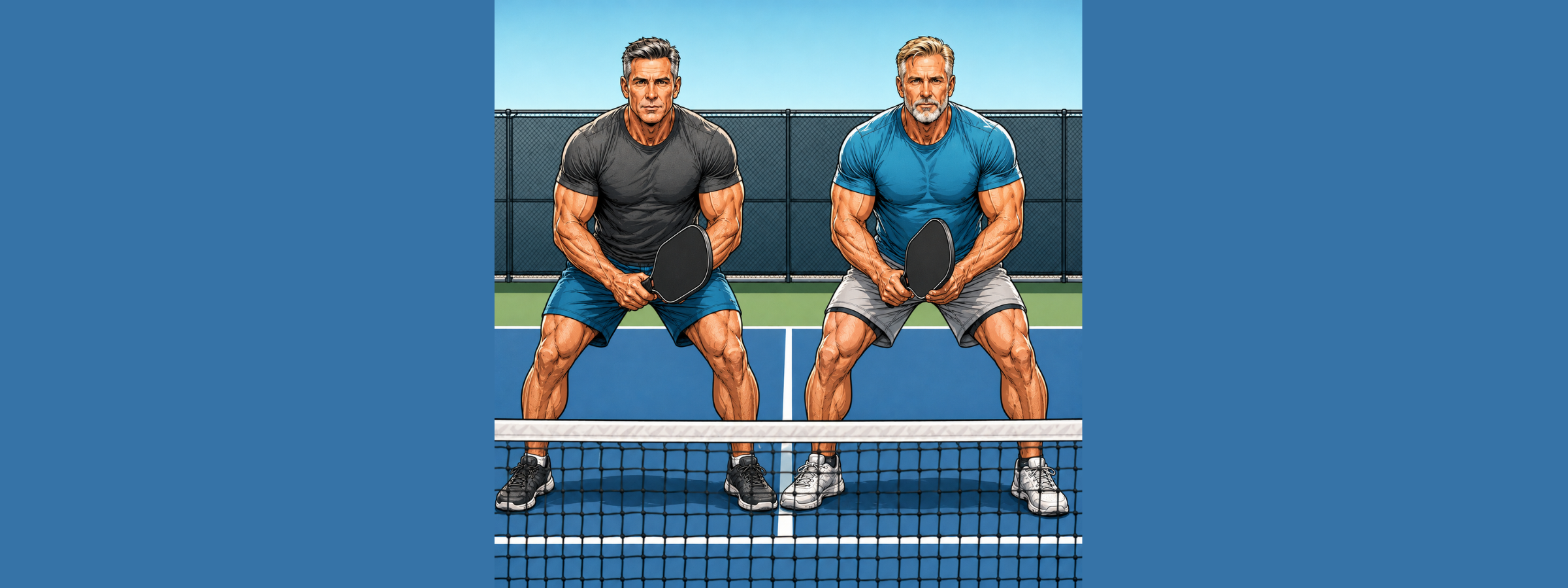
A: Playing against stronger players can make you feel like everything is happening too fast.
Their shots seem heavier.
Their resets seem cleaner.
Their attacks seem better timed.
Their mistakes seem smaller.
That can make you feel like you need to do more.
Hit harder.
Aim closer to the lines.
Speed up sooner.
Try shots you normally would not try.
Usually, that is the exact wrong response.
When you are playing against stronger players, the goal is not to suddenly play like them.
The goal is to become harder to beat.
That means focusing on the parts of the game you can control: your positioning, your shot selection, your patience, your balance, and your ability to make them earn points instead of handing them away.
First: Stop Trying To Impress Them
This is one of the biggest traps.
When players face stronger opponents, they often start playing outside themselves. They go for bigger serves, sharper angles, harder drives, and faster speed-ups because they feel like normal pickleball will not be enough.
But stronger players are usually waiting for that.
They are very good at punishing low-percentage shots.
If you try to win points too quickly, you usually make the match easier for them.
Instead, your first goal should be simple:
Make them play one more ball.
Not a perfect ball.
Not a highlight shot.
Just one more ball.
Stronger players are still human. They miss. They get impatient. They make poor choices when rallies get extended. But they rarely give you those chances if you panic early.
Second: Protect Your Court Position
Against stronger players, bad positioning gets exposed quickly.
If you are late getting to the kitchen, they will keep you back.
If you drift too far toward the middle, they will beat you down the line.
If you stand upright after your shot, they will attack your feet.
If you get stuck in transition, they will make you hit difficult balls from awkward spots.
So your focus should be:
Get balanced before contact.
Recover after every shot.
Move with your partner.
Avoid reaching when you should be moving your feet.
Stronger players do not always beat you with spectacular shots. A lot of the time, they simply notice that you are slightly out of position and make you pay for it.
That means your footwork and recovery matter more than trying to hit bigger winners.
Third: Play With More Margin
This may sound too simple, but it is one of the smartest adjustments you can make.
Against stronger players, do not live on the sidelines.
Use safer targets:
Deep middle on serves and returns
Middle of the court during faster exchanges
Crosscourt dinks with margin
Resets that clear the net comfortably
You are not lowering your standards.
You are raising your percentage.
Stronger players often win because they give themselves margin. They are not trying to paint lines on every shot. They hit aggressive balls to smart areas.
You should do the same.
A ball to the middle may not look exciting, but it often takes away angles, forces communication, and gives you time to recover.
It also makes your misses smaller.
Against stronger players, you probably will make mistakes. That is normal. The key is to avoid the big, automatic mistakes:
Return into the net
Third shot drive long by several feet
Speed-up from below the net
Wild attack off a low ball
Those are free points.
Against stronger players, you cannot afford too many free points.
A better miss is a ball that gives you a chance to keep playing. Miss long by a little, not a lot. Miss high with depth instead of into the net. Reset safely instead of trying to thread a perfect angle.
The stronger the opponent, the more valuable boring discipline becomes.
Fourth: Be Patient With Neutral Balls
One mistake players make against stronger opponents is assuming every neutral ball must be turned into offense.
It does not.
If the ball is low, neutral, or below net height, your job is usually to keep the rally stable.
That might mean:
Dink again
Reset again
Block instead of counterattacking
Let the ball bounce
Choose the middle instead of a sideline
You do not need to win the point from a neutral position.
You need to avoid losing it from a neutral position.
Stronger players are very good at baiting you into attacking balls that are not really attackable. They leave something that looks tempting, but the contact point is too low or your balance is not good enough.
Then you speed it up, and they counter.
Do not take the bait.
Wait for a ball you can attack with balance, contact in front, and a clear target.
Fifth: Pay Attention To Patterns
Stronger players usually have patterns.
They may:
Drive the third and crash
Dink crosscourt until you reach
Speed up when your paddle drops
Attack your backhand shoulder
Lob when you lean too far forward
Target the weaker mover in transition
Your job is not just to survive the rally.
Your job is to notice what keeps happening.
If they beat you the same way three times, that is information.
Maybe you need to keep your paddle higher.
Maybe you need to stop drifting.
Maybe you need to let more balls bounce.
Maybe you need to return deeper.
Maybe you need to stop speeding up from the same spot.
Against stronger players, improvement often comes from recognizing patterns faster.
You may not stop everything, but you can stop giving them the same opening over and over.
Sixth: Use Your Partner Better
When the other team is stronger, your partnership matters even more.
Talk between points.
Not a long strategy meeting. Just simple adjustments:
“Let’s return middle.”
“Watch the speed-up off her forehand.”
“I’ll cover middle if you get pulled wide.”
“Let’s make them hit one more ball.”
“Stay patient here.”
Strong teams often look better because they are more connected.
They move together. They know who takes middle. They know when to slow down. They know when not to panic.
You and your partner do not need a complicated plan.
You need a shared plan.
That alone can keep you from spiraling when the other team starts applying pressure.
Seventh: Measure Success Differently
If you are playing much stronger players, you may not win.
That does not mean the game was wasted.
Instead of only asking, “Did we win?” ask:
Did we make them work?
Did we extend rallies?
Did we reduce free mistakes?
Did we handle pressure better as the game went on?
Did we adjust to their patterns?
Those are real wins.
They also lead to actual improvement.
If you only judge the match by the score, you may miss the fact that you started reading the speed-up better, returning deeper, resetting more cleanly, or staying calmer under pressure.
That is how you close the gap.
Drills To Help You Compete Better Against Stronger Players
One More Ball Drill
Play points with one simple goal: you do not have to win the rally, but you must make your opponent hit one extra shot before the point ends.
No low-percentage speed-ups.
No sideline attempts unless the ball is clearly there.
No panic attacks from below the net.
This trains patience and discipline under pressure. It also teaches you how often opponents miss when you stop giving them easy points.
Big Target Drill
Play a game where your targets are limited to safe zones.
Serves and returns must go deep middle.
Dinks must go crosscourt or middle.
Resets must land safely in the kitchen, with height allowed.
No aiming for sidelines unless the ball is clearly attackable.
This builds the habit of choosing margin instead of perfection.
Against stronger players, that habit matters.
Pattern Recognition Drill
Play with a partner or group and choose one opponent pattern to watch for.
For example:
When do they speed up?
Where do they attack?
Do they target your backhand?
Do they lob after soft dinks?
Do they drive more often than drop?
After every few points, say out loud what you noticed.
This trains you to compete with awareness instead of just reacting.
A Quick Self-Check During Matches
When you are playing stronger players, ask:
Am I trying to do too much?
Am I giving myself enough margin?
Am I balanced before I attack?
Am I making them earn points, or giving them free ones?
Am I noticing their patterns, or just reacting emotionally?
Those questions will keep you grounded.
The Real Key
When you play stronger players, your focus should not be on matching their best shots.
It should be on improving your worst habits.
Stay balanced.
Use bigger targets.
Recover after every shot.
Make fewer free mistakes.
Attack only when the ball is truly attackable.
Make them play one more ball.
That may not make you the better team immediately.
But it will make you a tougher team to beat.
And over time, that is how stronger players stop feeling so far ahead.