
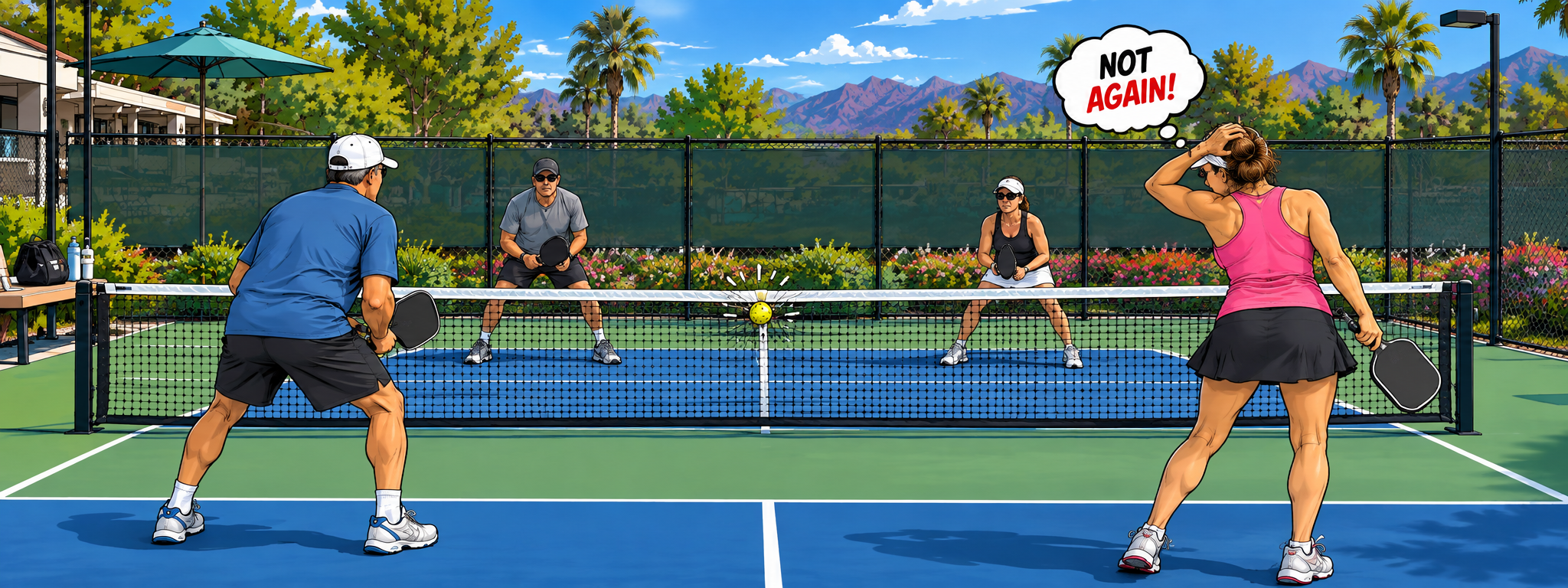
You did the hard part.
You hit a good third shot. You worked your way through the transition zone. You finally made it to the kitchen (non-volley zone) line.
Then your very first dink goes straight into the net.
Or you lift it too high and give your opponent an easy attack.
This happens a lot because the first dink after moving forward is different from a dink you hit after you’ve already been standing comfortably at the kitchen for several shots.
You’re changing from movement to control.
And if that change happens a fraction too late, the first dink is usually where it shows up.
First: arrive before you try to dink
One of the biggest mistakes is treating reaching the kitchen line and being ready at the kitchen line as the same thing.
They aren’t.
You may physically reach the line, but your body can still be moving forward. Your weight may still be drifting. Your feet may not be set. Your paddle may still be recovering from the previous shot.
Then the ball arrives.
Now you’re trying to hit a soft dink while your body is still finishing the trip forward.
That makes touch much harder.
As your opponents prepare to hit, settle your feet. A small split-step or balanced stop gives you a stable base before you have to play the next ball.
The goal is simple:
Move forward between shots. Get balanced before the next one.
Second: don’t run all the way into the line
Players are often so determined to “get to the kitchen” that they rush the last few feet.
Then they end up too close to the line, standing tall, or leaning forward when the ball comes.
You don’t need to crash into the kitchen line.
If you are arriving as your opponent is about to hit, stop where you are and get balanced. You can finish moving forward after the next ball if necessary.
Being six inches or a foot behind the line and balanced is much better than being right on the line and falling into your shot.
Once the rally gives you another chance, close the remaining space.
Third: get your paddle ready before the ball comes
Another common problem happens during the move forward.
Players hit a drop or reset, start moving, and let the paddle fall near the hip.
Then they arrive at the kitchen and suddenly have to bring the paddle back up while also reading the next shot.
That makes the first dink feel rushed.
As you move forward, bring the paddle back to a comfortable ready position in front of your body.
You want the paddle available before your opponent hits, not after you realize the ball is coming toward you.
This becomes especially important if the opponent changes direction and sends the ball wide or toward your backhand.
Fourth: loosen the grip after the transition
Moving through the transition zone often creates tension.
You’ve just handled a difficult drop, reset, or volley. You’re concentrating on getting forward. Your grip gradually tightens without you noticing.
Then you arrive at the kitchen with the same firm hand.
That can make your first dink jump off the paddle or travel farther than you intended.
Before that first soft exchange, consciously relax your hand.
You still need enough grip pressure to control the paddle, but the first dink should feel more like a gentle lift than a punch.
If the ball keeps popping up when you first arrive, grip tension is one of the first things to check.
Fifth: don’t try to make the first dink perfect
This is another sneaky problem.
You’ve worked hard to reach the kitchen, so now you want to hit a great dink immediately.
Maybe you aim for a sharp angle.
Maybe you try to skim the net.
Maybe you attempt to move your opponent with the very first ball.
That adds difficulty at exactly the moment when your balance and timing may still be settling.
Your first dink does not need to win the rally.
Its main job is to keep you in a strong position.
Choose a safe target. Give yourself reasonable net clearance. Make your opponent hit another ball.
Once you’re established and comfortable, you can start creating more pressure.
Sixth: use your legs instead of reaching
The first dink after moving forward often arrives low.
If your feet stop but your body stays upright, you may reach down with your paddle instead of lowering your body.
That creates a scoop.
And scoops usually produce one of two results:
The ball hits the net.
Or it floats too high.
Bend your knees and lower your body toward the ball. Keep the paddle in front and use a short, smooth motion.
Think about getting your body to the ball rather than sending your arm after it.
Watch for this pattern
If you consistently miss only the first dink but become comfortable once the dink rally starts, that tells you something important.
Your basic dinking technique may not be the problem.
The problem is probably the transition between movement and dinking.
Look for these clues:
- You’re still moving when you make contact.
- Your paddle is down while you approach the kitchen.
- Your grip is tighter on the first dink than later dinks.
- You reach instead of lowering your body.
- You try to hit a difficult target immediately.
- You arrive so close to the line that you have no room to adjust.
If later dinks feel easy but the first one doesn’t, focus your practice on the arrival—not just the dink.
Drills to Fix the First Dink
1. Drop, Move, Dink Drill
Start near the baseline with a partner at the kitchen.
Hit a third shot drop and begin moving forward.
Your partner returns a soft ball while you advance.
Before every shot, stop and get balanced. Continue moving forward until you reach the kitchen, then play the first dink.
Repeat the sequence rather than starting every drill already standing at the line.
The goal is to practice the transition from movement to touch.
2. First Dink Target Drill
Place a towel or target in the middle portion of the kitchen on the opposite side.
Start several feet behind your kitchen line.
Have your partner feed a ball while you move forward.
Get balanced, then play your first dink toward the large target.
Do not aim for the sidelines.
Once you can consistently land the first dink safely, gradually make the target smaller.
This trains control before precision.
3. Random Arrival Drill
Start in the transition zone.
Your partner feeds balls that allow you to move forward, but once you arrive near the kitchen, they randomly send the next ball to your forehand, backhand, or middle.
Your job is to stop, get ready, and play a controlled dink.
This keeps you from practicing only the perfect ball.
A Quick Self-Check During Matches
If you keep missing that first dink, ask yourself:
Am I actually balanced before I hit?
Is my paddle already in front?
Did I relax my grip?
Am I bending my knees or reaching?
Am I trying to do too much with this ball?
Would a simple, safe dink keep us in a good position?
Those questions can tell you more than changing your entire stroke.
Use One Simple Cue
As you approach the kitchen, think:
Arrive. Settle. Dink.
Not:
Run. Reach. Hope.
That tiny pause between movement and contact is often the difference.
The Real Key
The first dink after you reach the kitchen is not just another dink.
It is a transition shot.
You’re going from moving forward to holding your position. From defending and resetting to playing the soft game. Your body has to make that change before your paddle can.
Get balanced.
Get the paddle ready.
Relax your hand.
Choose a safe target.
Then dink.
Once you stop treating the first dink like something you have to hit while you’re still arriving, it starts feeling much more like all the other dinks you already know how to make.