
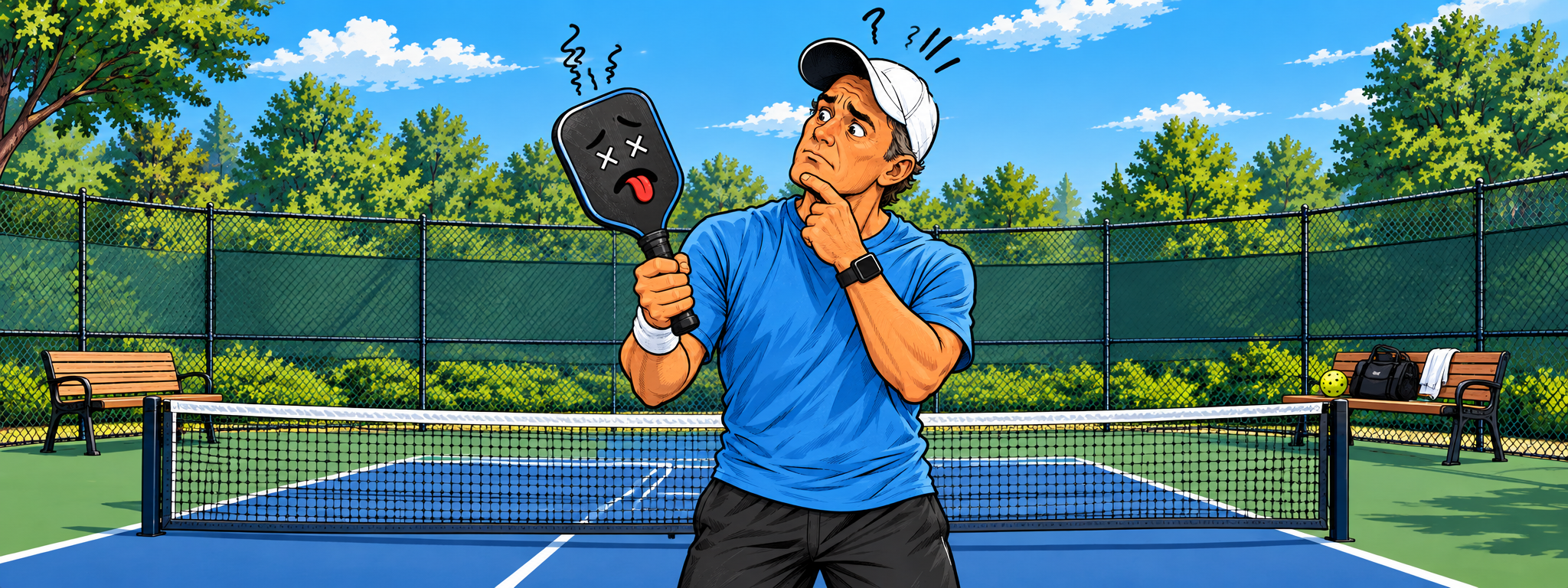
Sometimes a paddle just stops feeling right.
Shots that used to come off cleanly feel flat. Your drives do not have quite the same pace. Dinks feel different. Maybe the sweet spot seems smaller, or you find yourself swinging harder to get the same result.
That can make you wonder: Has my paddle actually gone dead, or am I just having a bad day?
Paddles can wear or develop structural problems. But one bad session — or even several — does not necessarily mean yours is finished.
The key is knowing what to look and listen for.
First: What Does a “Dead” Paddle Actually Mean?
When players say a paddle has gone dead, they usually mean it no longer responds the way it did when it was newer.
A paddle can change for different reasons. Surface texture can wear, which may affect the amount of spin you can create. Internal problems, including a crushed core or separation between bonded layers, can change the feel, sound, rebound, or consistency of the paddle.
Those are different kinds of wear.
If your paddle is not generating as much spin as it once did, the surface may simply be getting smoother. If certain areas of the paddle suddenly feel soft, dull, unusually springy, or noticeably less consistent, the issue may be deeper in the paddle.
So do not diagnose a dead core based only on losing a little spin.
Pay Attention to Changes in the Sweet Spot
One of the best clues is a sweet spot that suddenly seems different.
Hit several balls near the center of the paddle. Then intentionally move contact slightly toward different areas of the face.
You are looking for consistency.
If one section produces a noticeably weaker, softer, or different response than another — especially in an area that used to feel normal — that is worth paying attention to.
A worn or damaged paddle can start feeling less predictable. One ball comes off normally, while another struck almost identically seems to die on the face.
That is different from simply mishitting the ball.
Listen to Your Paddle
Your ears can sometimes catch a change before your hands do.
Hit the ball repeatedly around different areas of the paddle face. You can also lightly tap across the face with a ball or a non-damaging object and listen for repeatable changes in tone.
A paddle in good condition should sound reasonably consistent across comparable areas. If one area repeatedly produces a noticeably duller, hollower, or different sound, particularly when paired with a change in feel or performance, that can be another clue.
The sound alone does not prove anything.
You are looking for a combination of signs: different sound, different feel, and different ball response in the same area.
Compare It With Another Paddle
This is probably the easiest test.
If possible, borrow the same paddle model in newer condition and hit them side by side.
Do not start by crushing drives.
Hit:
- Dinks
- Blocks
- Volleys
- Controlled drives
Try to make the swings as similar as possible.
If your paddle repeatedly requires more effort to produce the same ball, or the ball comes off noticeably differently from certain parts of the face, you have much better evidence that the paddle — rather than your game that day — has changed.
Do Not Confuse Surface Wear With a Dead Core
If you are mainly noticing that your topspin is not biting as much or your slices are not moving like they used to, look at the paddle surface.
Texture wears with use.
A smoother face can reduce your ability to generate spin even though the core is still performing normally.
On the other hand, if you are noticing less response, inconsistent rebound, a changed sweet spot, and an unusual feel or sound, an internal structural issue becomes a stronger possibility.
That is an important distinction because “my paddle does not play like it used to” does not always mean the same thing.
Check for Physical Warning Signs
Give the paddle a basic inspection.
Look for obvious damage around the edge, face, and handle. Check for cracks, loose edge guard material, face bubbles, separation, or areas that feel noticeably different from the rest of the paddle.
Also pay attention to anything unusual when you move or lightly handle the paddle, such as internal rattling, localized softness, or a crunching sound when the face is gently pressed.
Visible damage is not required for a paddle to lose performance, but physical changes combined with performance changes make the case much stronger.
Rule Out Your Own Game Before Replacing It
Before blaming the paddle, consider what else has changed.
Have you been:
- Making contact farther from the sweet spot?
- Gripping tighter?
- Playing with a different ball?
- Playing indoors instead of outdoors?
- Playing in substantially different temperatures?
All of those can change how a paddle feels.
That is why the best test is not, “Does my paddle feel bad today?”
It is:
“Does my paddle repeatedly behave differently under the same conditions?”
Consistency is the clue.
Try This Simple Paddle Test
You do not need special equipment.
1. Sweet Spot Test
Hit 10 controlled balls from the center of the paddle, then repeat slightly above, below, and to either side of center.
You are looking for an area that consistently feels or performs unusually different.
2. Sound-and-Feel Test
Have a partner feed easy balls while you pay attention to both sound and vibration. Does one area repeatedly feel or sound different?
3. Side-by-Side Test
If you can borrow a newer version of the same model, alternate paddles every few balls. Do not intentionally change your swing.
The difference should show itself if it is repeatable.
When Should You Actually Replace It?
Do not replace a paddle because of one bad afternoon.
Start considering replacement — or contacting the manufacturer if the paddle may be covered by warranty — when you are seeing several signs together:
- The sweet spot has changed
- The response has become inconsistent
- Certain areas feel unusually dull, soft, or different
- The sound has changed
- You have visible damage, rattling, face separation, or other structural warning signs
- You have lost performance that cannot be explained by technique, balls, or conditions
That is much stronger evidence than simply thinking, “This paddle does not have the pop it used to.”
The Real Key
Paddles do not come with a warning light that says they are finished.
And there is no single shot that proves a paddle has gone dead.
Look for a pattern.
Feel. Sound. Response. Consistency.
If all four are telling you something has changed — and a side-by-side comparison confirms it — you are probably not imagining things.
Your paddle may simply have reached the end of its best playing days.