
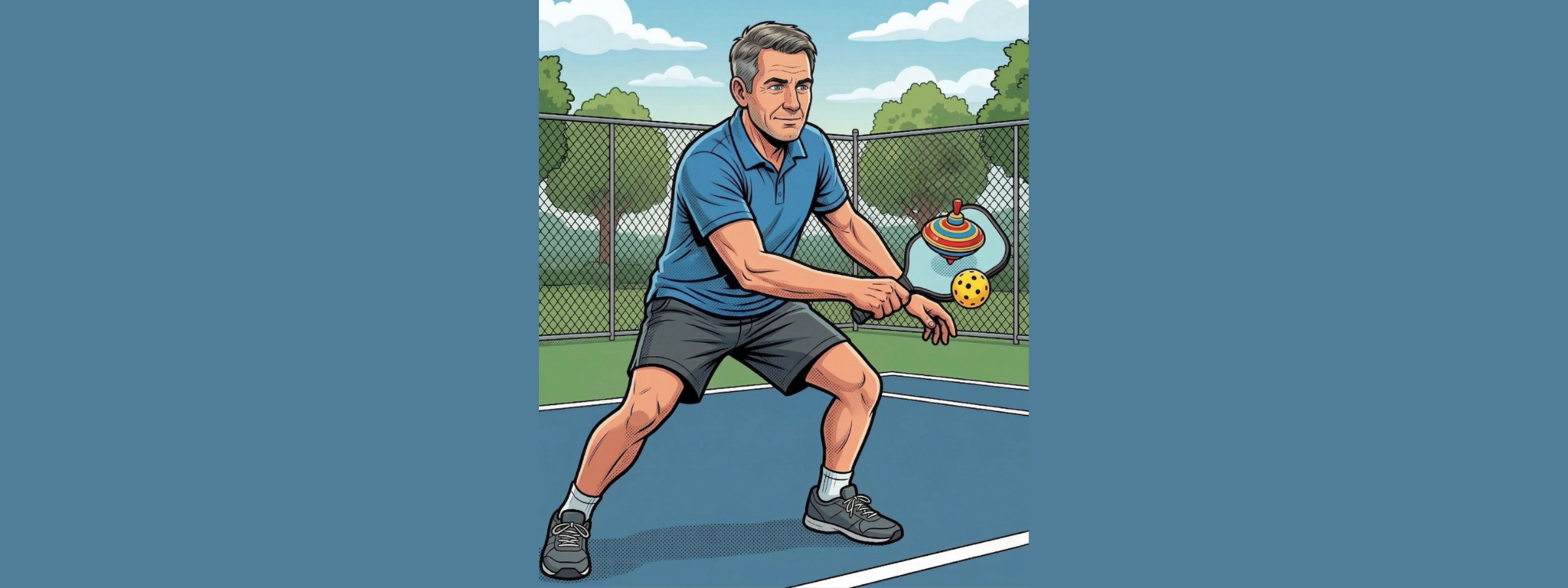
A: Topspin is one of those things players chase too early.
You see a forehand dip inside the baseline and kick up, and it looks like control plus power.
So you try to add spin.
And suddenly balls are flying long, dropping into the net, or coming off the paddle with no consistency.
The issue isn’t that topspin is hard.
It’s that most players try to add spin on top of an unstable swing.
Topspin doesn’t fix your forehand.
It amplifies it.
First: understand what topspin actually does
Topspin isn’t about hitting harder.
It’s about shaping the ball.
When you brush up the back of the ball, it rotates forward and dips back down into the court. That gives you margin over the net and helps keep deeper balls in.
But topspin is a tool — not something you need on every forehand.
A controlled, flat ball is still a great shot.
Spin is something you layer in once your contact is solid.
Second: use a simple, repeatable motion
Topspin comes from path, not effort.
The paddle should:
- Start slightly below the ball
- Travel low to high and forward
- Brush up the back of the ball — not under it
Think of it like this:
You’re not lifting the ball straight up.
You’re brushing up through it.
The paddle face should be slightly closed or neutral — not wide open.
If it’s too open, the ball floats. If it’s too closed, it dives into the net.
You don’t need a wrist snap.
You need a clean path.
Third: use your body, not just your arm
This is where most players lose control.
They try to create topspin with their arm or wrist alone.
Instead, let the motion build from the ground up:
- Legs load slightly
- Hips and shoulders rotate
- Arm follows
- Paddle brushes up through the ball
The arm and paddle guide the shot, but the body supports it.
If you try to muscle spin with just your forearm, timing breaks down and consistency disappears.
Fourth: get the contact point right
Topspin only works when contact is clean.
Aim to meet the ball a paddle-length in front of your hip, with your body balanced and your spacing comfortable.
If the ball gets too close, you jam yourself.
If it’s too far away, you reach and lose control.
Good spacing is what allows the paddle to move smoothly from low to high.
Without that, spin becomes guesswork.
Fifth: keep your grip simple
You don’t need to overhaul your grip to add topspin.
Use the forehand grip you already trust.
If topspin feels impossible, you can experiment slightly toward a more “shake hands” (eastern) position, which makes brushing up a bit easier.
But don’t chase extreme grip changes.
The swing path matters more than the grip.
Sixth: control comes from margin, not spin
This is where most players get it wrong.
They try to use topspin to “save” wild swings.
That doesn’t work.
Control comes from:
- Moderate swing speed
- Clear net margin
- Consistent contact point
At first, aim higher than you think.
Let the spin bring the ball down — don’t try to force it down.
If your shots start flying long, don’t try to spin them back in harder.
Reduce your swing speed slightly and rebuild the shape.
Seventh: choose the right balls for topspin
Not every ball is a topspin opportunity.
Topspin works best when:
- The ball is waist to chest height
- You’re balanced
- You can contact the ball in front
If the ball is low, stretched, or rushed, focus on control first.
Lift it. Reset it. Keep it in play.
Trying to force topspin from a poor position is one of the fastest ways to lose control.
Eighth: build it gradually
Topspin should come in layers.
Start with a reliable flat forehand.
Add a small low-to-high motion.
Then increase it slightly as your control improves.
If your consistency drops, dial the spin back.
Control first. Spin second.
Drills to build controlled topspin
Shadow Swing Drill
Without a ball, practice your forehand with a low-to-high path. Feel the paddle brushing up through contact. Keep it smooth and repeatable.
Depth Before Spin Drill
Hit forehands aiming deep with a mostly flat swing. Once you can land them consistently, add a small upward path.
This keeps control as the priority.
Controlled Feed Drill
Have a partner feed moderate, waist-high balls. Focus on clean contact and a gentle brushing motion.
Start at 50–60% pace. Increase gradually as control improves.
A quick self-check during matches
If your topspin forehand is breaking down, ask:
Am I contacting the ball in front?
Am I swinging smoothly instead of forcing it?
Am I using my body, not just my arm?
Those three answers usually point to the fix.
The real key
Topspin isn’t something you force.
It shows up when your fundamentals are in place.
Good spacing.
Balanced contact.
Smooth, low-to-high swing.
Controlled pace.
Add spin to a stable forehand, and you gain control.
Add spin to a rushed swing, and you lose it.
Start simple. Build gradually. Let the shape come from the motion — not from trying to make the ball do something extra.