
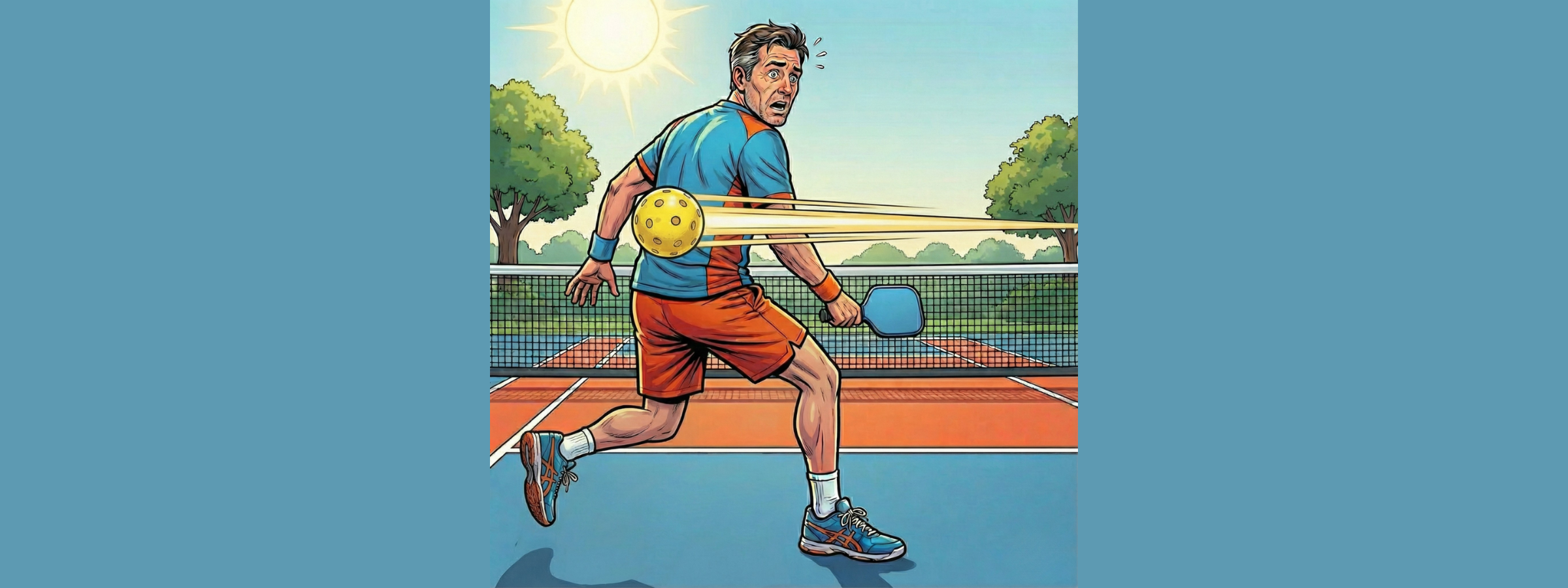
A:If you’re getting passed down the line over and over at the kitchen, it’s not because your opponents are “threading needles.” It’s almost always because you’re giving them the lane.
At the kitchen, every shot you hit creates new geometry. When you leave space along the sideline, you invite the highest-percentage attack in pickleball: the straight-line pass.
Here’s why it keeps happening—and how to shut it down without guessing.
The real reason it keeps happening
Most players think they’re losing to great shots. In reality, they’re losing to poor lane coverage.
At the kitchen, you are responsible for:
- The sideline on your side
- Your half of the middle
When you drift too far toward the middle or reach across your body to cover your partner’s ball, you abandon your sideline. Good players don’t miss that.
They aren’t hitting a risky angle.
They’re hitting the open court you left behind.
How your paddle and body give it away
Down-the-line passes are rarely surprises. They’re usually telegraphed by your position.
You’re vulnerable when:
- Your paddle drops below net height
- Your paddle points across the middle instead of down your line
- Your shoulders rotate toward your partner’s side
- Your weight leans inward instead of square to the net
All of those say the same thing:
“The line is open.”
Crosscourt dinks create straight-line danger
This is the most common setup:
You dink crosscourt.
You slide toward the middle.
Your sideline opens.
They go straight down the line.
Sliding one step is normal. Sliding too far is what creates the lane.
Any time your crosscourt dink sits a little high or drifts closer to the middle, expect the attack. Those are their green lights.
Your kitchen-line priority
The rule is simple:
Protect the line first. Then help in the middle when you’re set and the line is closed.
The middle is shared.
The sideline is yours alone.
If you give up the line, your partner cannot save you.
The “inside foot” mistake
One subtle habit makes this worse: stepping with your inside foot.
When the foot closest to the middle crosses in front of your outside foot:
- Your hips rotate inward
- Your shoulders turn
- You literally turn your back on the sideline
Stay square.
Use small shuffle steps.
Keep your outside foot anchored toward the line.
How to know it’s coming
Down-the-line attacks usually appear when:
- Your dink sits high
- You reach across your body
- Your paddle drifts inward
- Your opponent’s shoulders start to turn toward the sideline
That’s your warning.
When you see it, don’t panic.
Just close the door.
How to close the line
Before every dink or block:
- Paddle at chest height
- Paddle pointing slightly down your sideline, face neutral—not twisted toward the middle
- Body square to the net
If they attack at your shoulder or hip, create a few inches of space with a tiny sidestep instead of reaching. Space keeps your paddle path straight down the line.
You don’t need a big swing.
You need early position.
What NOT to do
Each of these habits does the same thing: it abandons your lane.
Do not:
- Lunge across your body
- Over-cover the middle
- Let your shoulders turn
- Let your paddle hang low
Those all open the same door.
Quick kitchen lane guide
| If you do this… | You invite this… | Fix |
| Drift toward middle | Down-the-line pass | Recover to your sideline |
| Paddle drops | Fast hands attack | Paddle at chest height |
| Reach across | Jammed body or open court | Stay square, create space |
| Step inside | Loss of balance | Shuffle, don’t cross over |
Drill: “Protect the Line”
Play crosscourt dinks only.
The straight line is live.
Middle attacks are not allowed.
Your job is to:
- Stay anchored to your sideline
- Keep your paddle protecting the line
- Help in the middle only when your line is sealed
You’ll feel how little you actually need to slide.
The takeaway
Down-the-line winners aren’t magic.
They’re geometry.
Close the door first.
Once your line is sealed, the middle becomes much easier to manage.