
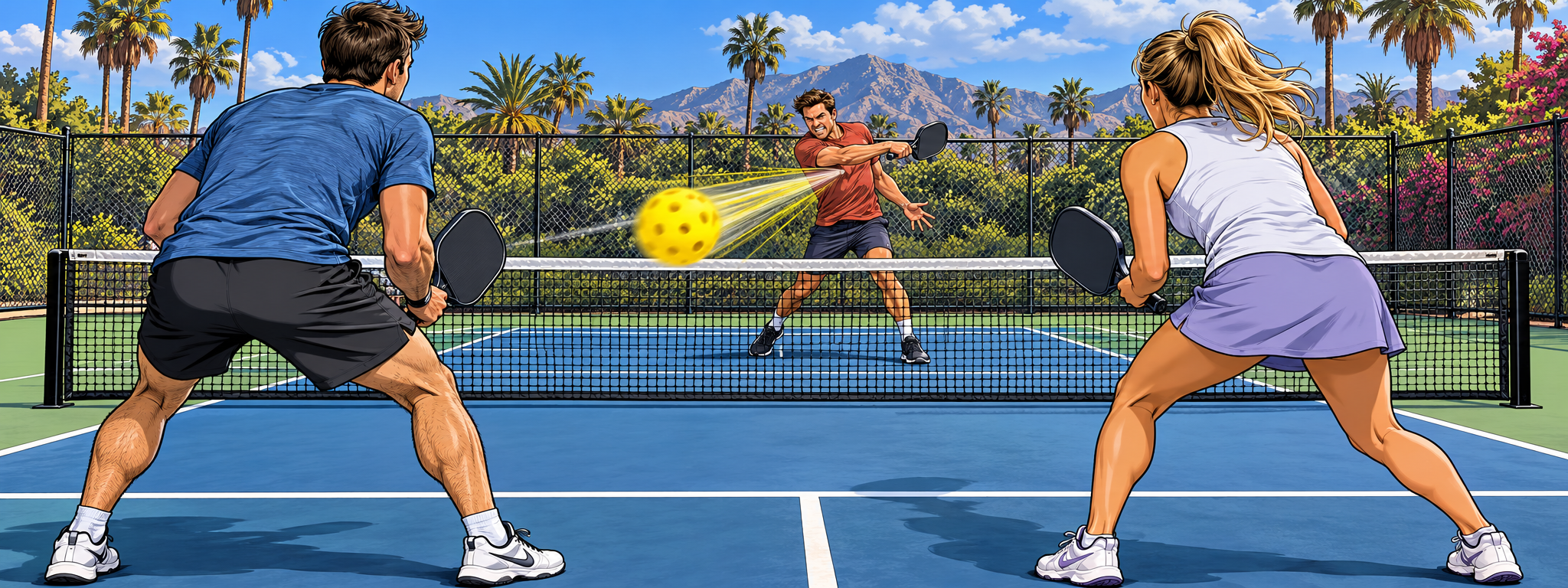
You’ve probably played against someone who seems determined to hit every ball as hard as possible. They drive their third shot, attack low dinks, and turn what should be a patient rally into a series of balls flying at your body.
It’s tempting to fight fire with fire. They hit hard, so you hit harder. Before long, you’re playing exactly the game they want.
The good news is that you don’t have to overpower a banger to beat one. You need to understand what their aggressive style gives you, recognize which balls are actually dangerous, and learn how to make their pace work against them.
The goal isn’t to stop them from hitting hard. It’s to make those hard shots less effective.
Understand What Bangers Want
A player who relies heavily on power wants you to feel rushed.
They want you reacting late, swinging too big, and making contact while you’re off balance. If you start trying to match their speed on every ball, you’ve allowed them to dictate the rally.
But hard hitters sometimes give up something in exchange for that pace.
They may have less control over placement, struggle to handle low balls, or become impatient when a rally doesn’t end quickly. Some are excellent at driving from the baseline but less comfortable hitting controlled shots from the transition zone.
Of course, not every powerful player has these weaknesses. Some can drive, dink, reset, and counterattack equally well.
Your job is to discover whether your opponent is simply hitting hard or actually controlling the point.
Watch what happens when you keep a ball low, take pace off a drive, or make them hit while moving. Their response will tell you more than the speed of their first shot.
Don’t Give Them Comfortable Attacking Balls
The easiest way to make a banger look unstoppable is to keep feeding them balls they can attack comfortably.
A floating dink, a high volley, or a drop that sits up gives an aggressive player exactly what they want.
Against someone who loves pace, the opponent’s contact point becomes especially important.
When you’re dinking, dropping, or resetting, try to make the opponent contact the ball below net height. From there, they have to send it upward to clear the net, which makes a hard attack more difficult to keep in the court.
This doesn’t mean every shot has to barely clear the net. You still need reasonable margin. A ball in the net doesn’t protect you from anything.
It also doesn’t mean a return of serve must travel low. A higher, deeper return can give you time to reach the kitchen and push the serving team back. The important distinction is between a ball that travels high and one that gives the opponent a comfortable high contact.
If you’re repeatedly getting attacked, look at the shot you hit immediately before the attack.
Often, that’s where the problem began.
Learn to Block Instead of Swinging Back
One of the most effective weapons against a banger is a compact block.
When someone drives hard at you, the incoming ball already carries plenty of energy. You don’t need to add much of your own.
Keep your paddle in front of your body, meet the ball with a stable paddle face, and avoid a large backswing.
Your grip should be secure enough to keep the paddle from twisting, but not so tight that every contact sends the ball springing back. Adjust the pressure to the incoming pace and the response you’re trying to produce.
A slightly open paddle face can help a low ball clear the net. Too much upward angle, however, can send the return floating high and give your opponent another comfortable attack.
When possible, take pace off the ball and direct it low into the kitchen.
Against an opponent who is still back, a short block can make them move forward and contact the next ball low. If they’re already advancing, a controlled ball near their feet may make the next shot awkward.
You don’t have to produce a perfect soft block every time. Sometimes the right response is simply a controlled volley that keeps the ball low and avoids giving away an easy next attack.
The point is to handle their pace without automatically adding more.
Make Them Hit From Uncomfortable Positions
Bangers are often most dangerous when they’re balanced and can step into the ball.
Your job is to take away that comfort.
Instead of repeatedly sending balls to the same location, vary your placement. Make them move sideways, reach for lower balls, or hit while adjusting their feet.
A deep return can keep a strong driver farther from the kitchen and give your team time to establish its position. It won’t prevent a good third-shot drive, but it can make the serving team’s approach more demanding.
Once the opponent moves forward, a low ball near the feet can force an awkward contact in the transition zone.
Placement doesn’t have to be spectacular to be useful. A controlled shot that makes the opponent hit while moving may do more for you than a harder ball delivered directly into their preferred strike zone.
Don’t assume that moving someone will make them miss.
The goal is to prevent them from setting up comfortably for the same powerful shot over and over.
Let the Out Balls Go
This may be one of the most valuable skills against players who attack too aggressively.
Some of the hard-hit balls players instinctively block would have landed beyond the baseline if left alone.
The problem is that fast balls feel dangerous. Your paddle comes up automatically, and you make contact before you’ve considered whether the ball was going to land in.
Start paying attention to the height and trajectory of your opponent’s attacks.
If someone speeds up a low ball and sends it climbing toward your shoulders while you’re at the kitchen line, consider whether it has enough court left to come down.
That’s not a guarantee that it’s going out. Topspin can bring a ball down quickly. Pace, contact location, and the direction of its flight all matter.
A useful cue is:
High and rising? Think out.
The word “think” matters. It’s a reminder to judge the ball, not permission to abandon every high shot.
You won’t judge every ball correctly, and you shouldn’t sacrifice your safety trying to dodge a ball at the last instant. Protect yourself when necessary.
But learning to recognize likely out balls takes away one of the banger’s biggest advantages: getting you to play shots you never needed to touch.
Don’t Be Afraid to Counterattack
Playing against power doesn’t mean you have to block everything.
Sometimes the best response to an aggressive shot is a controlled counter.
If your opponent sends a ball into a comfortable contact position and you’re balanced with the paddle ready, you may be able to redirect that pace back at them.
You don’t need a huge swing. A short, controlled counter can produce a quick reply while leaving you ready for the next ball.
Aim for a sensible target, such as an open space or the opponent’s body, rather than trying to hit a spectacular winner.
The key is recognizing the difference between a ball you can attack and one you need to defend.
If you’re stretched, late, or forced into an awkward low contact, a block or reset is usually the better choice.
If you’re balanced and the ball gives you a manageable counter opportunity, don’t automatically give it away.
A banger shouldn’t be allowed to assume that every attack will come back softly.
Change the Pace Without Giving Up Control
A banger wants a fast exchange. You don’t have to give them one.
Soft shots can disrupt their rhythm, especially if they’re accustomed to opponents responding with more power.
A well-placed dink makes them generate their own pace from a lower contact point. A controlled reset can take the pressure out of an exchange and return the rally to a more neutral situation.
But don’t confuse slowing the game down with simply hitting soft balls.
A soft shot that sits high is an invitation to attack.
Your goal is to change the pace while maintaining control of the ball’s height and placement.
Sometimes you’ll need several blocks or resets before the rally slows down. Sometimes the first good reset will be enough.
And sometimes your opponent will give you a ball worth countering before that happens.
Stay patient, but keep reading the next ball.
Position Yourself for the Next Attack
When you’re facing a player who frequently drives or speeds up the ball, your ready position becomes especially important.
Keep your knees comfortably bent, your weight balanced, and your paddle in front of your body. Avoid letting the paddle drop between shots.
At the kitchen line, be prepared to block, counter, or let an out ball pass.
If you’re moving forward, get balanced as the opponent prepares to strike. Continuing to run through the transition zone can make a manageable drive much harder to handle.
In doubles, your partner also needs to anticipate the attack. If one player is repeatedly targeted, the other should stay engaged and ready for a deflection, a change of direction, or the next ball through the middle.
Don’t lean so far forward that you’re reaching and unable to adjust.
But don’t retreat automatically every time you face a hard hitter, either. Giving up the kitchen line can provide more space for the opponent to attack your feet.
Make the positioning adjustment the ball requires, not the one your opponent’s reputation suggests.
Common Mistakes Against Bangers
The biggest mistake is trying to prove you can hit harder than your opponent.
Other common problems include swinging too much when blocking, feeding repeated balls at comfortable attacking heights, and touching shots that would have landed out.
Some players also become so focused on stopping the next drive that they forget to look for offensive opportunities of their own.
Others retreat after every attack, even when they could have handled the ball from a balanced position at the kitchen.
And perhaps the most damaging mistake is becoming impatient.
You don’t have to win every fast exchange immediately. Sometimes the best point against a banger is one where you calmly defend two or three attacks, send back a low ball, and make the opponent choose between slowing down and forcing another difficult shot.
Drill 1: Block and Reset
Have one player stand near the baseline and drive balls toward a partner positioned at the opposite kitchen line.
The player at the kitchen blocks the drives without taking a full swing.
The initial goal is to take pace off the ball and land it in the opposite kitchen. Once that becomes consistent, let the driver move forward after the drive so the blocker can also practice targeting the advancing player’s feet.
Start with moderate pace and gradually increase the speed. Hit 20 balls, then switch roles.
Pay attention to paddle angle, grip pressure, and how much your paddle moves through contact.
If your blocks repeatedly float high, shorten the motion and check whether your paddle face is too open. If the ball keeps dying into the net, check the face angle and whether you’re making clean contact in front.
The goal isn’t to make the paddle completely passive.
It’s to use only as much movement as the ball requires.
Drill 2: Play It or Let It Go
Position both players near their kitchen lines on opposite sides of the net.
The feeder sends a mixture of controlled speed-ups: some intended to land in and some intended to travel long.
For the first round, the receiving player calls “in” or “out” and lets every ball pass untouched. Compare the prediction with where the ball actually lands.
This gives the player feedback on balls they would normally volley.
Then begin a live round. The receiving player decides whether to block, counter, or move safely out of the ball’s path.
Award one point for a controlled return and one point for correctly letting an out ball go. Subtract one point for letting an in ball pass.
Don’t try to score whether a ball would have gone out after it has been hit. Use the untouched round to develop that judgment.
Begin with moderate, predictable feeds before increasing the pace and varying the placement.
This trains the decision that often matters more than reaction speed.
Drill 3: Neutralize the Attack
Begin a cooperative dink rally with one player designated as the attacker and the other as the defender.
The attacker initiates a controlled speed-up when a suitable ball appears. The defender works to neutralize the pressure with blocks, resets, and controlled placement.
The attacker continues attacking only when the return allows it. If the defender produces a low reset, play the ball appropriately rather than forcing another attack.
The defender earns one point when the team successfully returns to a neutral dink exchange. End the repetition and restart.
Play to five points, then switch roles.
As the drill becomes easier, allow the defender to counterattack when a genuinely manageable ball appears. A counter that wins the rally or forces a clearly defensive response also earns one point.
Now the defender has two ways to succeed: take the attack away or turn it around.
That is the decision you’re trying to develop.
The Bottom Line
The best way to beat a banger isn’t to become a better banger.
It’s to make their power less useful.
Keep your dinks, drops, and resets low. Use compact blocks. Make the opponent hit from uncomfortable positions, and learn which attacks are likely to travel out.
When they give you a ball you can counter, take the opportunity. When they don’t, stay patient and make them hit another shot.
Power is effective when it forces mistakes.
Your job is to stop giving it that advantage.