
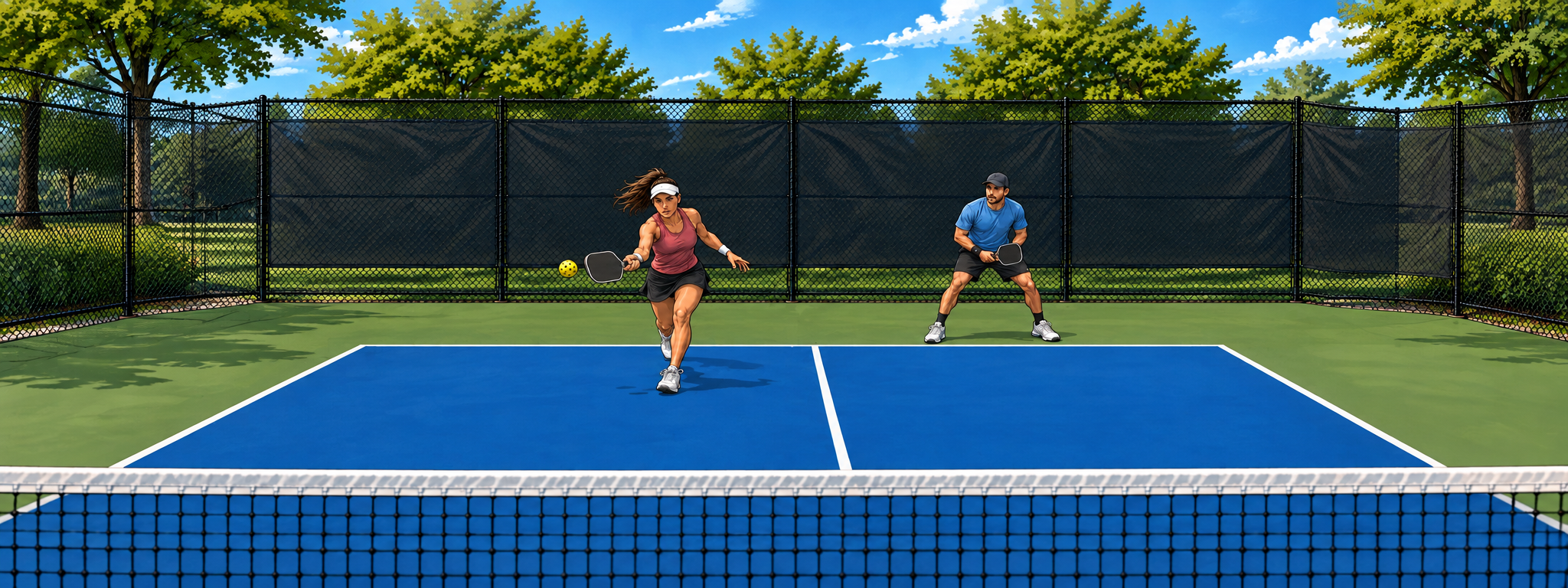
You hit a strong drive, see your opponents dealing with it at the kitchen line, and immediately start charging forward.
Sometimes that’s exactly what you should do.
Other times, you’re halfway through the transition zone when the ball comes screaming back at your feet.
The problem isn’t necessarily the drive. It’s assuming that every good drive is an automatic invitation to the kitchen (non-volley zone).
A third shot drive can create an opportunity to move forward, but the quality of your drive and your opponents’ response determine how far you should go. Instead of thinking, “I drove, so now I come in,” learn to read what your shot actually accomplished.
Your Drive Doesn’t Decide. Their Contact Does.
The most important part of deciding whether to advance happens after you’ve hit the ball.
Watch your opponents.
If your drive forces them to contact the ball low, reach, move sideways, or hit from an uncomfortable position, you’ve probably earned some forward movement.
If they are balanced, have the ball comfortably above net height, and are preparing to attack, continuing forward can put you in exactly the wrong place.
This is why blindly following every drive is dangerous. A hard drive isn’t automatically a good drive.
What kind of ball did my drive give them?
That answer tells you what to do next.
Low Contact Is Usually Your Green Light
Suppose your drive dips and your opponent has to contact it around knee level or below the top of the net.
That’s encouraging.
From that position, it’s difficult for your opponent to hit aggressively downward. They may block the ball, reset it, or send back a softer volley.
That’s your opportunity to advance.
You don’t necessarily need to sprint all the way to the kitchen line. Move forward while your ball is traveling, then get balanced before your opponent makes contact.
If their reply is soft, you may be able to continue forward and establish yourself at the kitchen.
If the reply is still difficult, stop in the transition zone, handle the next ball, and work your way forward from there.
Think of the trip to the kitchen as something you earn in stages rather than one continuous charge.
High Contact Is Your Warning
Now imagine your drive reaches your opponent around chest or shoulder height.
They aren’t defending anymore.
They’re attacking.
If you’re running forward as they strike the ball, you’ve created two problems for yourself. You’re moving when you need to react, and you’ve shortened the distance between yourself and an opponent who’s about to hit an offensive volley.
That’s when staying back, or at least stopping your advance, makes sense.
Being farther from the net gives you more reaction time and may allow you to defend the next ball more effectively.
This doesn’t mean you should retreat every time an opponent has an attackable volley. It means you shouldn’t continue charging forward simply because your original plan was to follow your drive.
Move While Your Ball Is Traveling
One of the biggest mistakes players make is waiting to see what happens before they start moving.
By then, it’s too late.
Your best opportunity to advance is while your own shot is traveling toward your opponents.
Hit the drive, begin moving forward, and then slow down and establish your balance as the opponent prepares to contact the ball.
That last part matters.
You don’t want to be running through your opponent’s contact.
A useful cue is:
Move, split, read.
Move while your ball travels. Get balanced as your opponent prepares to hit. Then read the reply before deciding whether you can continue forward.
Don’t Confuse “Stay Back” With “Never Move Forward”
There’s another common mistake at the opposite extreme.
Some players hit a drive and remain planted near the baseline until they see exactly what comes back.
That gives away the advantage their drive may have created.
You don’t have to choose between standing at the baseline and sprinting all the way to the kitchen.
There is plenty of court between those two places.
If your drive allows you to safely gain several feet, take them. Then stop, get balanced, and deal with the next ball.
A good transition may require two or three shots.
That’s completely normal.
Your Partner Matters Too
In doubles, your movement shouldn’t happen independently of your partner.
Ideally, both players advance together so you maintain a reasonably even formation.
If one player charges to the kitchen while the other remains near the baseline, you create a large gap that opponents can exploit. They can angle the ball between you or force one player to cover far more court.
You don’t need to be perfectly side by side at every moment, but think of the two of you as moving forward together.
If your partner hits the third shot drive, you should also be reading the opponent’s contact and adjusting your position accordingly.
The player who didn’t hit the ball has an advantage: they’re often able to watch the opponents sooner. Use that information.
What About a Really Good Drive?
Sometimes you’ll hit a drive so well that the opponent pops the volley up or produces a weak floating reply.
That’s when you should recognize that the drive has done its job.
Move forward aggressively and look for the next ball.
The drive itself may not win the point. Instead, it creates the weaker ball that lets you take control.
That’s an important change in mindset.
You aren’t always driving to hit a winner.
You’re often driving to earn a better fifth shot.
Common Mistakes
The most common mistake is automatically sprinting toward the kitchen after every drive. Other players make the opposite mistake and stay glued to the baseline even after forcing a weak response.
Players also tend to watch their own shot instead of watching the opponent who will hit the next ball.
Another problem is moving continuously. They start forward and never stop, even as the opponent is contacting the ball.
The solution is not simply “come in” or “stay back.”
It’s learning to advance when you’ve earned space and stop when you need stability.
Drills
Drill 1: Drive, Move, Split
Start with one player at the baseline and a partner at the kitchen line.
The baseline player hits a third shot drive and immediately begins moving forward.
Before the kitchen player contacts the ball, the advancing player must stop and establish a balanced ready position.
The kitchen player then volleys the ball back, and the baseline player plays the next shot from wherever they stopped.
Don’t worry about reaching the kitchen. The purpose is to develop the rhythm of hitting, moving, and getting balanced before the opponent’s contact.
Drill 2: Read the Contact
Have one player drive from the baseline while the partner at the kitchen varies the response.
Sometimes the kitchen player takes the ball comfortably above net height and attacks. Other times, they receive it low and send back a softer ball.
The driver must react accordingly.
Low, defensive contact means advance.
High, offensive contact means stop and prepare to defend.
Play 15 to 20 repetitions, then switch roles.
The driver shouldn’t decide what to do until they see the quality of the opponent’s contact.
Drill 3: Earn the Kitchen
Play out points beginning with a third shot drive.
The serving team isn’t allowed to sprint directly from the baseline to the kitchen. Instead, both players must advance according to the quality of each ball they create.
If they force a weak reply, they gain ground. If the opponents attack effectively, they stop and defend. If necessary, they reset from the transition zone before moving again.
The goal isn’t to reach the kitchen as quickly as possible. It’s to reach it under control.
The Bottom Line
Following your drive isn’t an automatic decision.
A good drive may earn you several feet, a weak reply may earn you the kitchen, and an attackable ball may tell you to stop exactly where you are.
Watch the height and quality of your opponent’s contact. Move while your ball is traveling, get balanced before they hit, and advance in stages when necessary.
The goal isn’t to get to the kitchen first.
It’s to get there without giving your opponents an easy ball on the way.