
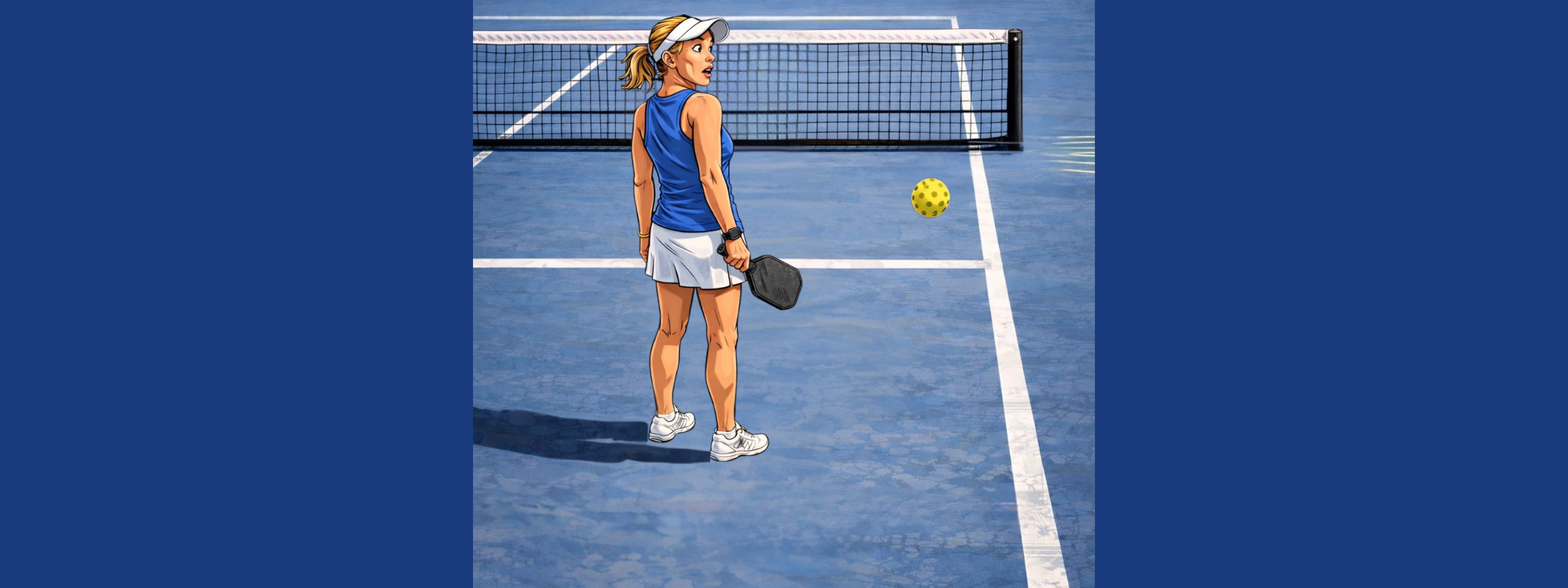
A: Getting passed down the line at the kitchen feels frustrating.
You’re in the rally. You’re dinking crosscourt. Everything seems under control… and then suddenly the ball goes right past you on your sideline.
It can feel like your opponent hit a perfect shot.
Sometimes they did.
But most of the time, they didn’t.
They hit the shot you gave them.
This is usually not about their accuracy.
It’s about your positioning.
First: understand your responsibility
At the kitchen, each player has a simple job:
Protect your line first.
Then help with the middle when you’re set.
Many players drift away from that without realizing it.
They get pulled into crosscourt dinks, slide too far toward the middle, or start leaning inside the court.
That opens the straight lane down the line.
Once that lane is open, the shot isn’t difficult.
Second: crosscourt dinks create straight-line danger
Most down-the-line winners come out of crosscourt dink rallies.
This is especially true for the outside player in that exchange.
You’re focused diagonally.
Your opponent is focused diagonally.
But the court doesn’t change.
The sideline is still there.
If you slide even a step too far toward the middle, you’ve created space they can attack.
You don’t need to move much to cover a dink.
A small adjustment is enough.
Anything more starts to open the lane.
Third: watch the quality of your ball
Down-the-line attacks usually come after a ball that gives your opponent a green light.
That means:
- Your dink sits a little high
- It drifts toward the middle
- It gives them time and balance
Any ball that lets them hit forward above net height is a potential attack.
When that happens, expect them to challenge your line.
That awareness alone will tighten your positioning.
Fourth: keep your paddle in the right place
A lot of line passes happen because the paddle isn’t ready.
Common mistakes:
- Paddle drops too low
- Paddle drifts toward the middle
- Body rotates away from the sideline
Instead:
- Keep your paddle up around chest height
- Keep it slightly oriented toward your line
- Stay square to the net
From that position, you can move to the ball quickly without reaching across your body.
Fifth: fix your footwork
Footwork is where most of these points are actually lost.
Players often:
- Cross their inside foot too far toward the middle
- Reach instead of moving
- Let their hips turn away from the sideline
When your inside foot crosses too far, your body rotates and you lose the ability to defend your line.
Instead:
- Use small shuffle steps
- Keep your base under you
- Move just enough to stay balanced
If a ball comes down the line, you want to be stepping toward it — not reaching across yourself.
Sixth: create space when needed
Not every down-the-line shot is clean.
Sometimes the ball is hit toward your body or shoulder.
When that happens, don’t reach across your chest.
Take a small sidestep to create space.
That gives your paddle room to move naturally and keeps your contact clean.
Seventh: don’t abandon the middle completely
Protecting your line doesn’t mean ignoring the middle.
The priority is:
Line first.
Middle second — once you’re balanced and set.
For example, if your partner gets pulled wide and you clearly see an attack coming toward the middle, you can step in and help.
But if you help too early or drift without a reason, you leave your line exposed.
Close the door first.
Then help when the play actually calls for it.
Drill to fix the problem
Protect the Line Drill
Play crosscourt dinks with a partner.
One rule: your opponent is allowed to attack down the line at any time.
Your job is to:
- Stay disciplined with your positioning
- Move only as much as needed
- Be ready for the straight-line shot
This quickly teaches how little movement is actually required — and how costly over-shifting can be.
A quick self-check during matches
If you keep getting beat down the line, ask:
Am I drifting too far toward the middle?
Is my paddle ready and in front of me?
Am I moving my feet or just reaching?
Was my last ball attackable?
Answer those honestly, and the fix becomes clear.
The real key
Down-the-line shots don’t come from nowhere.
They come from small openings.
When you:
- Stay disciplined with your positioning
- Keep your paddle ready
- Move with control instead of drifting
…the line stops being easy to attack.
And when that happens, your opponents go back to the safer shot.
Right where you want them.